
Review · LUXOR
Historia Hotel Nile Cruise, Mon. from Luxor 4 nts inc. Excursions
The best part of this four-night Nile cruise is the way it links Egypt’s major ancient sites into one moving journey. You unpack once, then wake near a different stretch of the river each day, with Karnak, the Valley of the Kings, Edfu, Kom Ombo, Philae, and Aswan built into the route.
I like the modern boutique-ship feel and the strong focus on food and service. I also like that the price includes full board, site admission, air-conditioned transfers, and the listed excursions. The main caution is cost: at $3,498 per person, this is a serious luxury purchase, and the sightseeing is described as a shared cruise group rather than fully private touring.
Key points to know before booking
- Four nights on the Nile: Sail from Luxor to Aswan, with checkout on Day 5.
- Major temples included: Karnak, Luxor Temple, Hatshepsut, Edfu, Kom Ombo, Philae, and the Unfinished Obelisk are all part of the route.
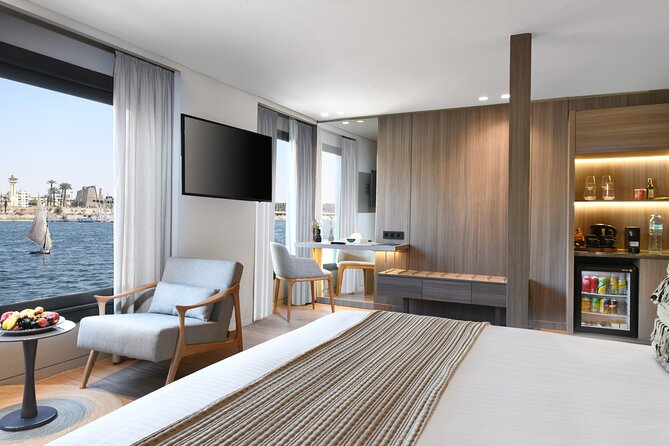
- Modern floating hotel: Cabins are described as clean, spacious, stylish, and fitted with clear Nile views.
- Food is a major strength: Full board includes four breakfasts, four lunches, and four dinners, with Egyptian buffet dining and special attention to dietary restrictions.
- Strong personal service: Staff members praised by name include Khaled, Hussein El Omada, ElHussein, and Executive Chef Mahmoud.
- Allow for weak internet: Wi-Fi works, but its reliability can be uncertain.
Why a Nile cruise makes sense for this route
A Nile cruise is not simply a boat ride between sightseeing stops. It is a practical way to connect Luxor and Aswan without repeatedly changing hotels or arranging long road transfers. You carry your luggage aboard once, then let the river set the pace.
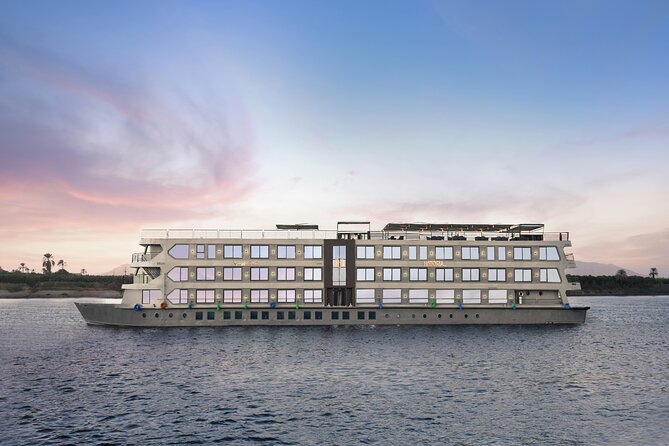
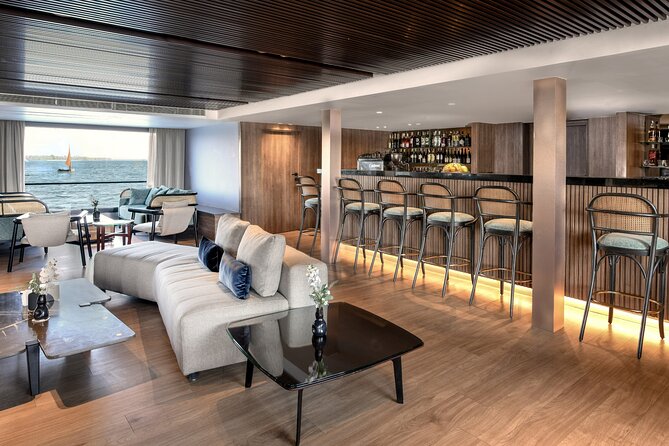
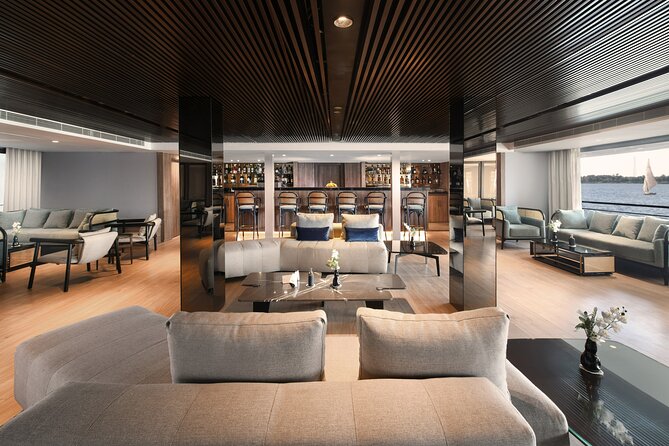
Historia is presented as a boutique hotel on the water, with modern rooms, a top deck, onboard entertainment, dining, and a spa called Seneb. The ship is aimed at people who want comfort and service rather than a bare-bones river journey. You can spend the hot part of the day indoors, return to the ship after temple visits, and watch the river pass from the deck.
The schedule gives you two main sites on most sightseeing days. That is efficient, but it also means this is not a slow archaeological study tour. Expect organized visits, set excursion times, and plenty of walking over stone surfaces.
More Nile Cruises in Luxor:
- From Luxor: 3-Night Nile Cruise to Aswan and Hot Air Balloon
★ 3.7 · 297 reviews - 5 Days Private Guided Nile River Cruise Tour from Luxor to Aswan
★ 5.0 · 229 reviews - From Luxor: 5-Day Nile Cruise to Aswan with Balloon Ride
★ 4.2 · 168 reviews
Day 1: Karnak and Luxor Temple in ancient Thebes
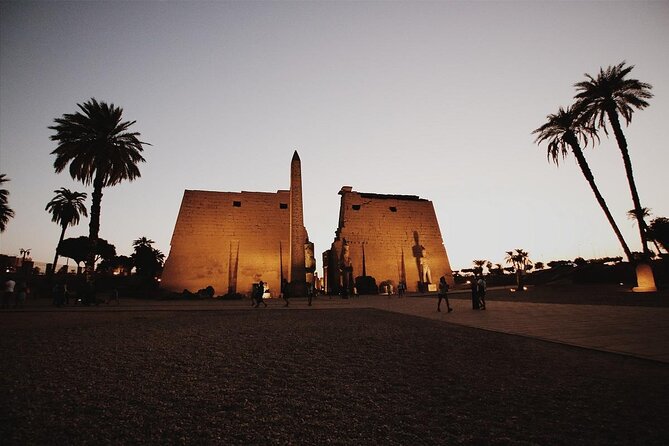
Your first sightseeing day begins with Karnak Temple, the largest religious complex ever constructed. Allow about two hours here. The scale is the point: huge pylons, columns, chapels, damaged walls, and layers of construction spread across a large area.
Karnak developed over roughly 2,000 years and was closely tied to Amun, along with Nut and Khonsu. The ancient name, Ipet-isut, means The Most Selected Places. A good guide can help you make sense of the site’s many rulers and additions instead of leaving you to see only a forest of stone.
You then visit Luxor Temple, also for about two hours. It sits on the east bank and was built around 1400 BC. Unlike a temple focused on one god or one burial, Luxor Temple was linked to the renewal of kingship. That gives it a different feel from Karnak, even though the two sites are connected by their religious traditions.
I would pay close attention to the contrast between the two visits. Karnak impresses through size and layers. Luxor Temple feels more concentrated, with a clearer sequence of courts, columns, and monumental entrances.
The first day is also a useful test of the pace. Two large sites can be tiring, especially in strong sun. Wear shoes with a firm sole, carry water, and save some energy for the evening aboard ship.
Day 2: Pharaohs’ tombs and Hatshepsut’s dramatic temple
Day 2 moves to the west bank and begins at the Valley of the Kings. About 63 tombs have been identified here, ranging from simple chambers to long corridors with many rooms. The names linked with the valley include Ramses II, Tutankhamun, and Seti I.
The exact tombs available for entry can vary, so do not assume every famous tomb is included simply because the pharaoh is associated with the valley. The main value of the visit is seeing how royal burial moved underground, into corridors and chambers cut into the rock.
The valley is physically demanding in a different way from Karnak. You may walk over uneven ground and exposed paths, with little shade. The two-hour allocation gives you time to see the site, but you will want to manage your pace.
Next comes the Temple of Hatshepsut at Deir el-Bahari. Built below steep cliffs, the temple uses terraces and broad lines to create a powerful setting. It was dedicated to Hatshepsut and Amun, and its reliefs tell the story of Hatshepsut’s divine birth and royal authority.
This is one of the more memorable stops because the building and its setting work together. The cliffs rise directly behind the terraces, making the temple easy to understand as a statement of power. It also gives your guide a chance to explain Hatshepsut’s unusual position as a female pharaoh.
The listed time is two hours at each stop. That is enough for a well-led overview, but serious Egyptology fans may wish they had longer. The value here lies in having transport, admission, and a guide organized for you, not in unlimited time at each monument.
Day 3: The double temple at Kom Ombo
The cruise continues south to Kom Ombo, a Ptolemaic temple with an unusual design. Its courts, rooms, halls, and sanctuaries are duplicated, with one side dedicated to Sobek, the crocodile god, and the other to Horus the Elder, the falcon god.
The symmetry makes this site particularly easy to appreciate during a guided visit. You can see how a single complex served two divine traditions, with the layout divided along a central axis. The temple also offers a different architectural period from the older sites around Luxor.
You then visit Edfu Temple, dedicated to Horus. It was built from sandstone between 237 and 57 BC and is considered one of Egypt’s best-preserved temples. Its walls contain inscriptions about religion, mythology, and language.
Edfu is valuable because so much of the structure remains legible. Instead of trying to imagine every missing wall, you can follow the surviving spaces and inscriptions. A guide can point out details that would be easy to miss, especially if you do not read hieroglyphs.
Both visits are scheduled for roughly two hours. That makes Day 3 another full sightseeing day, but the two temples are distinct enough to avoid feeling repetitive. Kom Ombo gives you the unusual double plan. Edfu gives you a more complete sense of a temple complex.
The cruise itself matters on this day. Returning to a familiar cabin and dining room after two temple visits is easier than facing another hotel change. It also lets you see more of the Nile between stops, rather than treating the journey as empty transfer time.
More river trips worth booking around Luxor:
- Luxury 5 Days Nile River Cruise from Luxor to Aswan with Private Tour Guide
★ 5.0 · 114 reviews - From Cairo: 4-Day Nile Cruise to Aswan w/ Balloon & Flights
★ 3.6 · 86 reviews - 5 Day 4 Night – Deluxe Nile Cruise Luxor to Aswan – Private Tour
★ 5.0 · 86 reviews - Aswan: 3-Day Nile River Cruise to Luxor with Guided Tours
★ 4.4 · 62 reviews
Day 4: Philae, the Unfinished Obelisk, and Aswan
Day 4 focuses on Aswan and begins with Philae Temple. The supplied description refers to Elephantine Island, but Philae is commonly associated with a temple complex reached by boat near Aswan. Since the exact transfer details are not specified here, confirm the precise arrangement before departure.
The temple is associated with Isis and is known for its setting among the waters and islands around the First Cataract. The broader Aswan area once played an important role in trade, including ivory, and marked the southern edge of ancient Upper Egypt near Nubia.
Philae is often one of the most atmospheric visits on a Nile itinerary because the water changes the way you approach the monument. It feels different from a temple surrounded by open desert or city streets. Plan for sun and walking, and listen carefully to the guide’s explanation of how the site relates to Aswan’s geography.
The second stop is the Unfinished Obelisk, left in a granite quarry after cracks appeared during carving. If completed, it would have measured about 42 meters and weighed roughly 1,090 tons. It would have been larger than any finished ancient Egyptian obelisk.
This is not a finished monument, and that is precisely why it matters. The exposed stone shows how ancient workers began shaping a colossal object before abandoning it. The quarry gives you a practical look at stone-working methods, including the risks involved in extracting one piece from bedrock.
Both Day 4 visits are listed at two hours. Together, they provide a useful balance: Philae shows finished religious architecture, while the obelisk shows the work behind monumental construction.
Day 5: A quiet finish in Aswan
The final day is less structured. You spend about two hours enjoying views of Aswan before checkout. No admission fee is listed for this portion.
That slower finish is welcome after four days of temples and tombs. Aswan is one of the best places on this route simply to sit near the river and watch local boat traffic, islands, and changing light. The experience ends in Aswan city, near the Nile Corniche and the cruise port.
The stated end point is Diverso Cafe, at the Nile Cruise Port area. Since the tour begins at Luxor Airport at noon and ends in Aswan, you should plan flights, hotels, and onward transport around those specific points. Transport to and from Historia Nile Cruise is not included, so budget for that separately.
Rooms, dining, and life aboard Historia
The ship’s main selling point is its hotel-like comfort. Cabins are described as modern, clean, spacious, and furnished with Nile views. That matters because the room becomes your base between early sightseeing, meals, and time on deck.
The strongest pattern in the available feedback is service. Staff members such as Khaled and Hussein El Omada receive repeated personal recognition, while Chef Mahmoud is praised for both the standard of the food and the effort made for families and special diets. Those details suggest a service culture that is attentive rather than merely formal.
Meals are included on a full-board basis:
- Four breakfasts
- Four lunches
- Four dinners
The dining program includes varied food, fresh presentation, and an Egyptian buffet evening. Dining on deck around sunset is one of the simple pleasures built into a river cruise, although the schedule and weather will affect how much time you spend outside.
If you have food restrictions, tell the operator before sailing. The information provided indicates that dietary needs have been handled carefully, but advance notice is still the sensible approach.
The ship also offers entertainment and a Seneb spa. These are useful additions, but I would treat them as extras rather than the reason to book. The real value is having a comfortable base while moving through Egypt’s major ancient sites.
Internet is the clearest weakness mentioned. It may work, but reliability can be uncertain. If you need dependable contact for work, medical matters, or airport arrangements, prepare a backup plan rather than counting on onboard Wi-Fi.
Guide quality and the question of private touring
The overview describes private cars and in-person guides if you book the sightseeing package. The included section, however, says that the Nile Cruise excursions operate in a shared cruise group. Those descriptions do not fully match.
That does not make the trip a poor choice, but you should ask one direct question before paying: Are my excursions private, or am I joining the ship’s shared group? Also ask about guide language and whether the same Egyptologist accompanies you throughout.
Names connected with strong guide experiences include Mohammed, who guided in Spanish, and Tarek or Terek, who was praised for clear assistance on the tours. You cannot assume you will be assigned one of them, but you can request your preferred language and confirm guide arrangements.
A good guide changes the experience at Karnak, the Valley of the Kings, and Edfu in particular. Without context, you see stones. With clear explanations, you understand why the sites were built, how they relate to one another, and what details deserve your attention.
Is $3,498 per person a fair price?
At $3,498 per person, this sits firmly in the luxury bracket. The value depends on how much you would otherwise spend arranging a high-end hotel, four nights of meals, site admissions, transfers, guides, and transport between Luxor and Aswan.
The price includes all fees and taxes, sightseeing admission, assistance during the stay and excursions, modern air-conditioned vehicle transfers, full-board accommodation, and the listed cruise excursions. That removes much of the day-to-day planning burden.
Still, the price does not include transportation to and from Historia Nile Cruise. It also does not clearly promise private sightseeing in every case. If you are comparing options, request a complete list of what the $3,498 covers, including guide language, cabin category, airport transfers, and any additional boat or site transport.
I see the best value here for someone who wants comfort, organized touring, and strong onboard service in one purchase. It is harder to justify for a budget-conscious visitor who mainly wants transportation between temples.
Who should book this cruise?
I would recommend Historia to you if you want to see Luxor and Aswan without managing every transfer yourself. It suits couples, families, and first-time visitors who care about clean modern rooms, good food, and attentive staff.
It is also a good fit if you prefer a compact itinerary with the major sites covered. The route is efficient and culturally substantial, but it is not designed for long independent exploration at each monument.
You may want another option if you need highly flexible schedules, guaranteed private guides, constant internet, or a lower price. The cancellation terms are strict: the experience is non-refundable and cannot be changed once booked, except when poor weather or an insufficient number of participants causes the operator to cancel.
Should you book Historia?
Book it if you want the Nile to function as both your transport and your hotel. The combination of modern cabins, full-board meals, included admissions, and major temples makes the planning easy, while the staff and chef appear to be central strengths.
Before committing, confirm the cabin type, guide language, private versus shared touring, and transport to the ship. If those details suit your needs, Historia offers a polished way to travel from Luxor to Aswan with the ancient sites placed right in the middle of the journey.
FAQ
How long is the Historia Nile Cruise?
The experience lasts approximately five days and includes four nights aboard the cruise.
Where does the cruise begin?
The stated starting point is Luxor Airport in Luxor, Egypt.
What time does the experience start?
The listed start time is 12:00 pm.
Where does the cruise end?
The cruise ends in Aswan city near the Nile Corniche and the Nile Cruise Port. The stated end point is Diverso Cafe.
Which ancient sites are included?
The route includes Karnak Temple, Luxor Temple, the Valley of the Kings, the Temple of Hatshepsut, Kom Ombo Temple, Edfu Temple, Philae Temple, and the Unfinished Obelisk.
Are meals included?
Yes. Full board includes four breakfasts, four lunches, and four dinners.
Are admission fees included?
Yes. Sightseeing fees and all fees and taxes are included.
Is transportation to and from the cruise included?
No. Transportation to and from Historia Nile Cruise is not included.
Are the excursions private?
The overview refers to private cars and in-person guides with the sightseeing package, while the included details describe the listed excursions as shared Nile cruise group tours. Confirm the arrangement before booking.
Can the booking be canceled for a refund?
The experience is non-refundable and cannot be changed for any reason. If the operator cancels because of poor weather or because the minimum number of participants is not met, you will be offered another date, another experience, or a full refund.
Newly added river trips around Luxor
- From Cairo: 4-Day Nile Cruise to Aswan w/ Balloon & Flights★ 3.6 · 86 reviews
- From Cairo: 4-Day Nile Cruise from Aswan to Luxor with Meals★ 4.4 · 24 reviews
- From Aswan: 4-Day 3-Night Nile Cruise with Hot Air Balloon★ 4.5 · 50 reviews
- Aswan to Luxor: 4-Day Luxury Dahabiya Nile Cruise Adventure★ 4.7 · 28 reviews
- Aswan: 3-Day Nile River Cruise to Luxor with Guided Tours★ 4.4 · 62 reviews
- From Cairo: 8-Day Tour to Luxor and Aswan with Nile Cruise★ 4.5 · 2 reviews
- 5 Days 4 Nights Nile Cruise from Luxor, Aswan & Abu simbel★ 4.1 · 9 reviews
- 4-Night, 5-Star Nile Cruise from Luxor to Aswan★ 4.5 · 55 reviews
Luxor River Cruises, compared.

3-Night Nile Cruise to Aswan and Hot Air Balloon
Read our review →
5 Days Private Guided Nile River Cruise Tour from Luxor to Aswan
Read our review →
5-Day Nile Cruise to Aswan with Balloon Ride
Read our review →
Luxury 5 Days Nile River Cruise from Luxor to Aswan with Private Tour Guide
Read our review →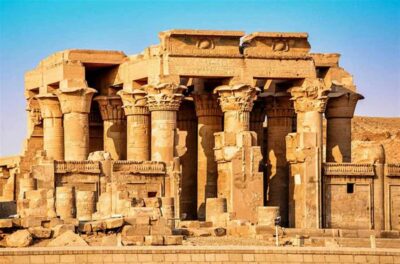
4-Day Nile Cruise to Aswan w/ Balloon & Flights
Read our review →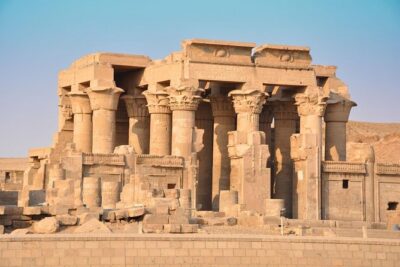
5 Day 4 Night – Deluxe Nile Cruise Luxor to Aswan – Private Tour
Read our review →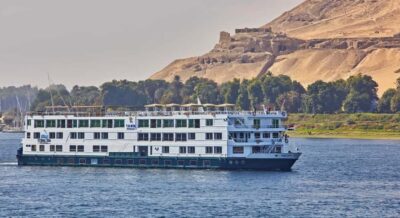
3-Day Nile River Cruise to Luxor with Guided Tours
Read our review →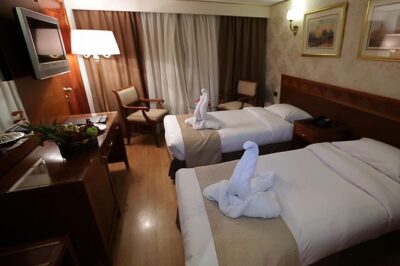
4-Night, 5-Star Nile Cruise from Luxor to Aswan
Read our review →Lists this sailing appears in