
Review · CHICAGO
Chicago Architecture Center River Cruise aboard First Lady
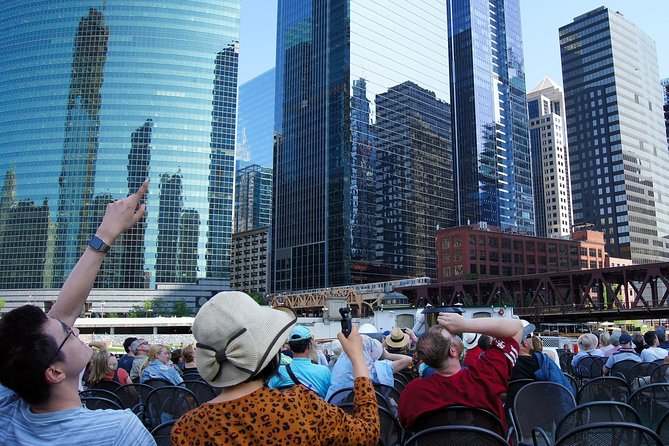
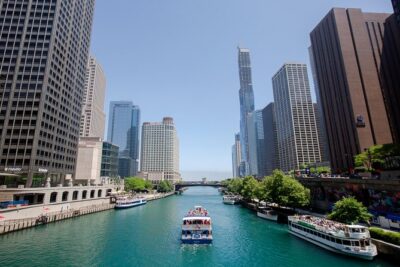
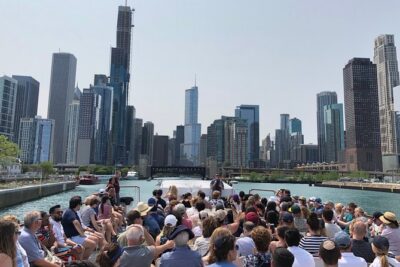
Chicago’s most revealing street is its river. From the deck of Chicago’s First Lady, you get a clean view of the city’s famous towers while a trained Chicago Architecture Center docent explains why they look the way they do. The boat moves slowly enough for photos, but the city keeps changing around every bend.
I like the expert volunteer docents, who bring far more context than a basic sightseeing cruise. I also like the 90-minute length, long enough to cover a large slice of downtown without eating half your day. The main drawback is the open seating: arrive late and the best outdoor spots may be taken, especially on a busy summer sailing.
Key points to know before you book
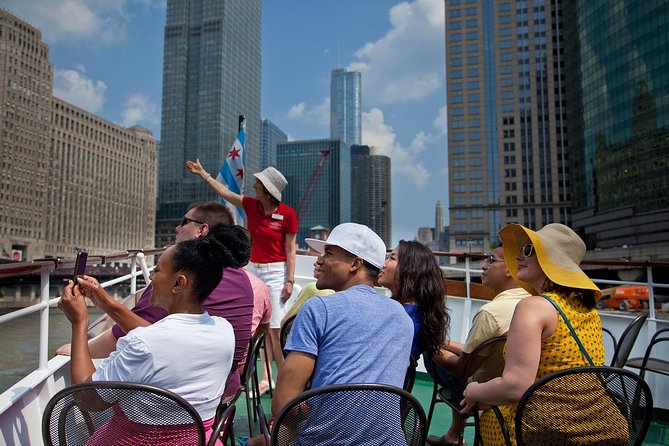
- The river is the real classroom: You see Chicago’s buildings from angles that streets and sidewalks cannot provide.
- Docents make the difference: Guides such as Cynthia, Laura, Amy, Russell, Nick, and Mark have offered lively explanations of architecture, city planning, bridges, and local history.
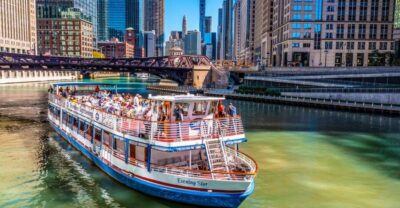
- The boat works in poor weather: An open upper deck gives you the best views, while the lower salon is enclosed and climate-controlled.
- Arrive 30 minutes early: Seating is general admission, and boarding is first come, first served.
- The $57 price buys more than a view: You get a full guided program, restroom access, and a 90-minute route through central Chicago.
- Plan around the restrictions: Tickets cannot be refunded or moved, luggage is not accepted, and the dock has no elevator access.
Why Chicago’s river cruise is worth your time
Chicago’s architecture is easiest to understand from the water. On land, you look up at one tower at a time. From the river, you can compare old warehouses, early skyscrapers, sleek modern offices, and daring new engineering projects within a few minutes.
That comparison is the heart of the cruise. The docent does not simply point at buildings and recite names. The explanations connect a building to its neighbors, its purpose, and the changing role of the river. You hear about industry, shipping, suburban migration, downtown redevelopment, and the city’s long habit of using architecture to solve practical problems.
I would schedule this early in a Chicago visit. The cruise gives you a useful mental map, so later walks around the Loop, the Magnificent Mile, and the Riverwalk make more sense. Several people use it as an orientation tour because it shows such a large section of central Chicago in one sitting.
The boat covers the route in about 90 minutes. That is a good compromise. You get enough time to learn something substantial, yet the outing remains manageable for families, couples, and anyone fitting several sights into a busy day.
More river trips worth booking around Chicago:
- Chicago Architecture River Cruise
★ 5.0 · 15,756 reviews - Chicago: Architecture River Cruise Skip-the-Ticket Line
★ 4.8 · 4,325 reviews - Chicago: 45-Minute Family-Friendly Architecture River Cruise
★ 4.7 · 2,304 reviews
Boarding from the Riverwalk
The departure point is at 112 East Wacker Drive, on the Chicago Riverwalk. The entrance is at street level on the northeast corner of Michigan Avenue and Wacker Drive, close to the Chicago Architecture Center and a short walk from Millennium Park and the Magnificent Mile.
Allow at least 30 minutes before departure. You need time to find the Riverwalk entrance, collect or confirm your boarding ticket, and join the line. In summer, allow extra time because the area can be crowded.
The ticketing office is on the Riverwalk level of Wacker Drive. If you book through an outside ticket seller, do not assume the phone confirmation itself gets you straight onto the boat. Allow time for the boarding process and any required ticket handling.
There is no assigned seating, even if a seat number appears on your ticket. Ignore it and choose your place after boarding. The best outdoor seats naturally go first, so early arrival matters if you want an unobstructed view.
The dock has no elevator access. Keep that in mind if stairs are difficult for you or someone in your group. Service animals are allowed, and most people can take part, but pets are not permitted. Children must have an adult with them, and the experience is not recommended for children under 12.
The boat, the bar, and the weather plan
Chicago’s First Lady has two useful viewing levels. The upper deck is open to the air and gives you the clearest sightlines for tall buildings and bridge details. The lower salon is enclosed and climate-controlled, with large windows that let you keep watching the city in rain, wind, or cold.
Dress for the forecast, but also dress for shade. Even on a pleasant day, the river can feel cool, and tall buildings can block the sun. A cap, visor, or sunglasses help when the sun reflects off glass towers.
The cruise operates in all weather conditions. That is a practical advantage, but it also means you should not book it assuming perfect skies. The indoor level keeps the trip usable in rain and cold, though your photographs will generally be better from the open deck.
There is a full bar onboard, with drinks and light snacks available for purchase. Hot chocolate has been a particular hit on cold departures. Restrooms are available, but they close 15 minutes before the tour ends for safety reasons.
There is no WiFi, and the boat has no luggage storage. Leave suitcases at your hotel. A stroller can come onboard, but you must remove the child before boarding, then fold and store the stroller in the salon during the cruise.
The maximum group size is 250 people. That is large enough to feel like a real city cruise rather than a private outing, but the docent uses a microphone and the boat is designed for a guided program.
The Chicago River and the city’s changing story
The opening stretch introduces the Chicago River itself. This waterway has served industry, transportation, shipping, and recreation, and its changing role mirrors the city’s own changes.
That context gives the cruise purpose. You are not simply floating past office buildings. You are seeing a corridor that helped Chicago grow and later became a place for public access, dining, walking, and sightseeing.
The river also gives you a better sense of scale. Downtown towers rise tightly along the banks, while bridges repeatedly frame the view. The boat’s slow movement lets the docent point out details that would be easy to miss from a passing car or a crowded sidewalk.
Expect the narration to shift between architecture and civic history. One moment may concern an architect’s design choice. The next may explain how the river supported trade or how a building fit into a larger plan for bringing people back downtown.
Same river, a different boat:
- Chicago: 1.5-Hour Lake and River Architecture Cruise
★ 4.7 · 2,050 reviews - Chicago River 90-Minute Architecture Boat Tour
★ 5.0 · 1,635 reviews - Chicago by Night River and Lake Cruise
★ 4.6 · 791 reviews - Chicago: Fireworks Cruise with Lake or River Viewing Options
★ 4.3 · 551 reviews
Navy Pier, seen as adaptive reuse
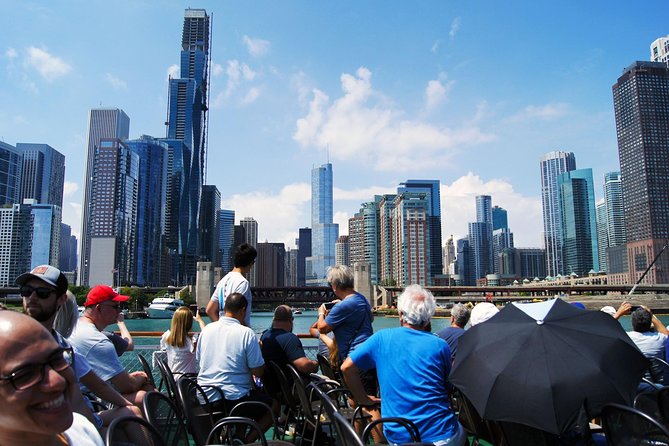
Navy Pier appears as a major example of a place that has changed jobs over time. It has served as a naval base, a university campus, a shipping hub, and an entertainment destination.
From the water, the pier is easier to read as part of Chicago’s working waterfront rather than just a place for rides and restaurants. The point is not simply to spot Navy Pier, but to understand how large urban structures can survive by finding new uses.
The view is also a useful reminder that Chicago is not only a collection of skyscrapers. The city’s identity comes from its piers, bridges, warehouses, public spaces, and commercial buildings as much as its famous towers.
Marina City and Chicago’s urban experiment
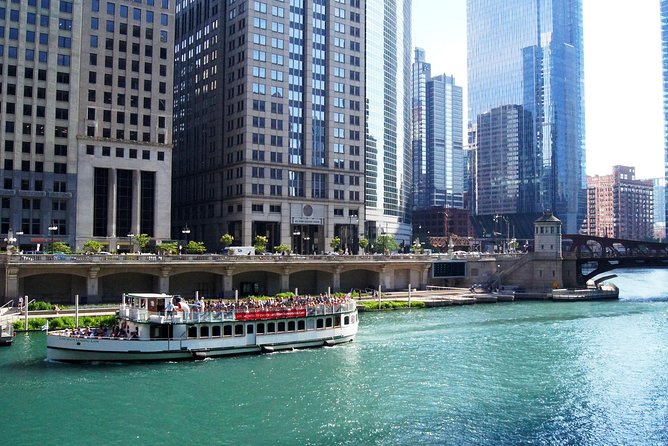
Marina City is one of the most memorable sights on the route. Its paired, rounded towers were designed by Bertrand Goldberg as an urban experiment intended to bring middle-class residents back to the city after years of suburban migration.
The design is easy to recognize from the river, but the social goal makes it more interesting. The towers were not only an architectural stunt. They were part of an effort to combine housing and city life in a period when many people were leaving downtown neighborhoods.
Your guide may use Marina City to explain how architecture responds to social conditions. That is one of the cruise’s strengths. The buildings become evidence of what Chicago hoped to achieve at different moments, not just objects to photograph.
Trump Tower and the idea of architectural context
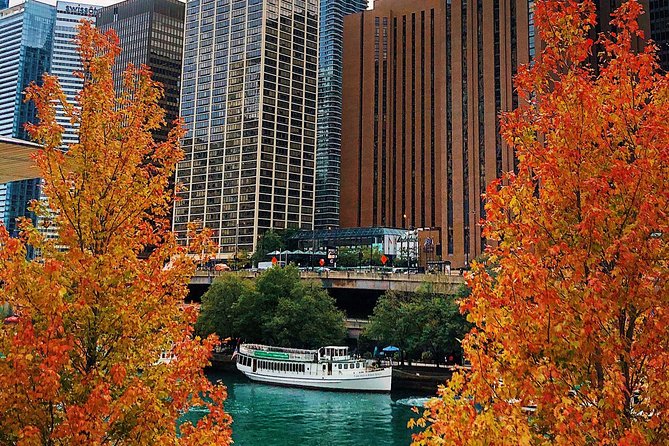
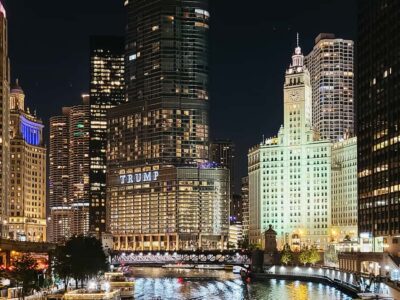
The Trump International Hotel & Tower provides a chance to discuss how a new building responds to its surroundings. Its glass and steel exterior catch the eye, but the docent’s explanation goes beyond the surface.
The useful lesson is that buildings do not exist alone. Their height, materials, position, and relationship to the river affect the view around them. From the boat, you can see those relationships more clearly because the river creates distance and gives you a long sightline.
This part of the route may appeal to you if you like modern design, though some of the building discussion is more about urban fit than decorative detail. The cruise keeps moving, so listen closely when the docent shifts from one building to the next.
Modernism at 330 North Wabash
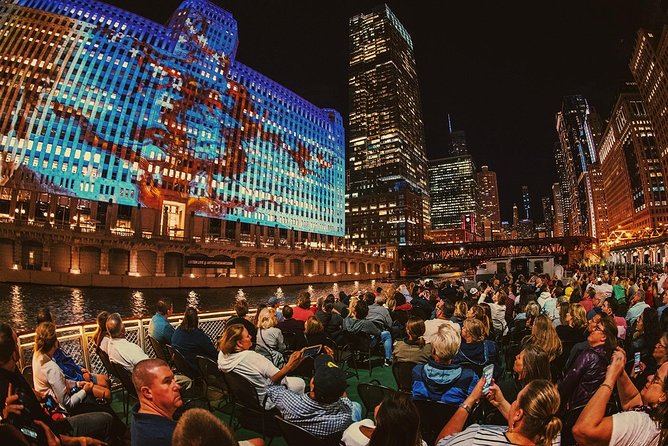
The powerful Modernist structure designed by Ludwig Mies van der Rohe occupies an important position along the river. It is one of the last American projects associated with this major architect.
The building’s appeal comes from its restraint. Instead of elaborate ornament, the design depends on proportion, structure, glass, and steel. Seen from the river, it makes a useful contrast with the rounded Marina City towers and the more reflective towers nearby.
This is where a docent-led cruise earns its price. You can admire a building on your own, but the explanation of how one design differs from another gives your eyes a way to sort what you are seeing.
150 North Riverside and modern engineering
The slender 150 North Riverside is one of the route’s most striking engineering stories. Its narrow base and broad upper floors create the impression that the building is balancing above the riverfront.
From a sidewalk, you may focus on its unusual shape. From the boat, you can better judge how little of the structure touches the ground and how dramatically it rises above the river. The building adds a recent chapter to the route, showing that Chicago’s habit of testing structural limits did not end with the early skyscrapers.
The view is especially strong for photographs, but remember that the boat does not stop at every building. Keep your camera ready and listen for the guide’s cue.
Boeing headquarters and the scale of downtown
The cruise passes the Boeing International Headquarters at 100 North Riverside Plaza. This section helps fill in the spaces between the route’s headline buildings.
That is important because the cruise is not a parade of only the most famous towers. You see how corporate headquarters, older commercial structures, and newer offices fit into one dense river corridor. The docent’s commentary gives those buildings a reason to matter.
The changing mix of styles also keeps the route from feeling repetitive. Glass, stone, steel, concrete, rounded forms, and strict geometric lines all appear within the same 90-minute program.
Willis Tower and the race upward
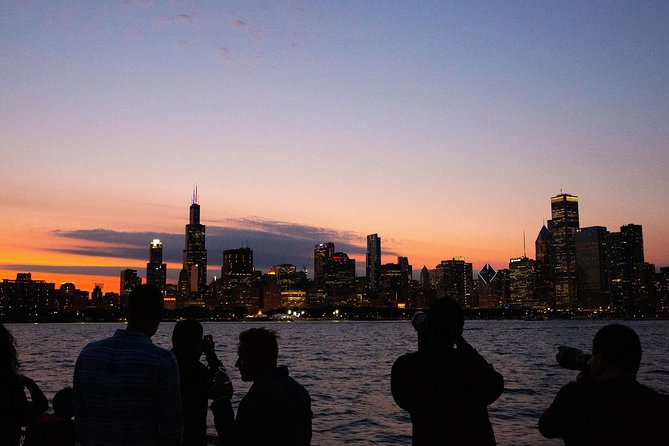
Willis Tower, formerly known as the Sears Tower, held the title of the world’s tallest building for nearly 25 years after its completion. From the river, its height is easier to grasp than from the base, where nearby buildings can block the view.
The tower is a strong example of Chicago’s role in the history of tall buildings. Its importance is not just the number of floors or its former title. The guide explains the ambitions behind it and places it within the city’s longer effort to build upward.
If you have visited the Skydeck, the cruise gives you a different view of the tower. If you have not, it still provides a useful preview without requiring a separate admission ticket or a long visit.
The Merchandise Mart and the city’s commercial past
Size mattered in Chicago, and the Merchandise Mart shows that clearly. When it opened in 1930, it was the largest building in the world and served as Marshall Field’s wholesale warehouse, where retailers could buy stock.
That original purpose makes the building more than a huge block beside the river. It reflects Chicago’s importance as a commercial center, where goods moved through the city and businesses needed enormous spaces to display and distribute them.
The Mart also helps you see how the riverfront once supported trade and wholesale activity. The cruise keeps the building connected to the city’s economic past rather than treating it as another impressive facade.
The Chicago Mercantile Exchange and the route back
The Chicago Mercantile Exchange Building at 20 South Wacker Drive appears toward the end of the route. Its presence points to the city’s continuing importance in finance and commerce.
By this stage, you have seen housing experiments, corporate offices, former warehouses, engineering showpieces, and landmarks linked to Chicago’s trading economy. The route back to the dock ties those themes together.
The return is a good time to review the buildings you want to revisit on foot. The cruise ends where it began, near the Riverwalk and Chicago Architecture Center. Show your cruise ticket at the center for discounted $5 admission, a useful add-on if you want models, exhibits, and more background after seeing the actual buildings from the water.
What the $57 price really buys
At $57 per person, this costs more than a simple sightseeing boat ride. The price makes better sense if you value the live docent program, because the architecture commentary is the main reason to choose this cruise over a basic river outing.
You also get 90 minutes of sightseeing, a restroom, indoor seating, and access to an open deck. The route covers a large section of central Chicago without requiring multiple train rides or long walks between buildings.
The value is strongest for a first visit, a short stay, or anyone who wants a clear introduction to Chicago’s architecture. If you already know the city well and only want a quiet boat ride, you may find the guided format less appealing.
The cruise is highly rated, with a 4.9 score from more than 5,500 ratings and 98 percent of customers recommending it. Those numbers fit the experience’s strongest qualities: clear organization, comfortable boats, and guides who bring personality to the subject. Still, I would treat the price and nonrefundable ticket rule seriously. Choose your departure carefully.
Who should book Chicago’s First Lady
I would book this for a first Chicago visit, architecture fans, couples, families with older children, and anyone who wants an efficient introduction to downtown. It also works well on the first day because the route helps you plan later walks.
You will get the most from it if you listen closely and keep your eyes moving between the guide and the buildings. The boat is not a hop-on, hop-off service, and it does not give you time to explore each landmark on foot.
The experience suits people who like context as much as scenery. Guides such as Cynthia, Laura, Amy, Russell, Nick, and Mark have been singled out for lively delivery, clear explanations, and strong command of Chicago’s architecture and history. The exact docent varies, but the program is built around that personal presentation.
Should you book it?
Yes, if you want to understand Chicago rather than simply photograph it. The river gives you the best broad view of the city’s architecture, and the docent helps turn a wall of towers into a readable story about design, business, migration, transportation, and urban change.
Book early in your trip, arrive 30 minutes ahead, dress for wind and shade, and aim for the upper deck if the weather allows. Choose another activity if you need flexible cancellation, luggage storage, elevator access to the dock, or a very quiet ride. For most visitors, though, this is one of the smartest ways to spend 90 minutes in downtown Chicago.
FAQ
Where does the Chicago Architecture Center River Cruise depart?
The cruise departs from 112 East Wacker Drive along the Chicago Riverwalk. The Riverwalk entrance is at street level on the northeast corner of Michigan Avenue and Wacker Drive.
How early should I arrive?
Arrive 30 minutes before departure. Allow additional time during summer, when the area and boarding process may be busier.
Is seating assigned?
No. Seating is general admission and boarding is first come, first served. Any seat numbers printed on tickets are not valid.
Is the cruise available in bad weather?
Yes. The cruise operates in all weather conditions. The upper deck is open-air, while the lower salon is enclosed and climate-controlled with large windows.
Can I buy food or drinks onboard?
Yes. A full bar is available, and drinks and light snacks can be purchased during the cruise.
Can I bring luggage?
No. Luggage is not allowed onboard, and there is no luggage storage at the dock. Leave it at your hotel.
Are restrooms available?
Yes. Restrooms are available onboard, but they close 15 minutes before the end of the cruise.
Can I bring a stroller or pet?
Strollers are allowed, but children must be removed before boarding. The stroller will be folded and stored in the salon. Pets are not allowed, though service animals are permitted.
Newly added river trips around Chicago
- City Cruises Chicago: Brunch, Lunch, or Dinner River Cruise★ 4.7 · 128 reviews
- Chicago: Tiki Bar Cruise on Chicago River or Lake Michigan★ 3.8 · 16 reviews
- Chicago River: 90-Min Architecture Boat Tour★ 4.9 · 29 reviews
- Chicago River 90-Min Architecture Boat Tour★ 4.5 · 24 reviews
- Chicago: Thanksgiving Gourmet Lunch Cruise on Chicago River★ 3.5 · 4 reviews
- Chicago River: 1.5-Hour Guided Architecture Riverboat Tour★ 4.7 · 93 reviews
- Chicago Night Driving Tour with Skydeck and River Cruise★ 4.4 · 44 reviews
- Chicago: Narrated Sightseeing River and Lake Cruise★ 4.7 · 268 reviews
Chicago River Cruises, compared.
Architecture River Cruise Skip-the-Ticket Line
Read our review →
45-Minute Family-Friendly Architecture River Cruise
Read our review →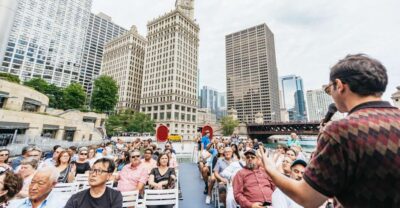
Chicago River 90-Minute Architecture Boat Tour
Read our review →
Fireworks Cruise with Lake or River Viewing Options
Read our review →
Lists this sailing appears in